Verdict: NO · 2018
Where the Crawdads Sing: the marsh stays, the mystery doesn't
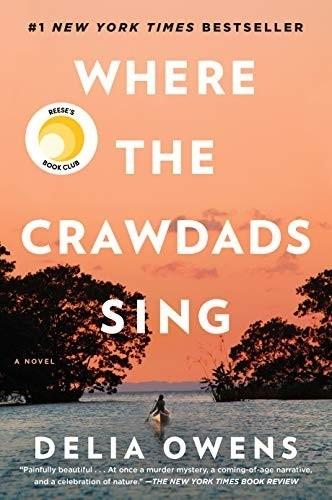
NO. Read it once. Don't reread it. Where the Crawdads Sing earns its first read on atmosphere and a well-timed mystery, and gives back almost nothing once you know how the mystery ends.
What worked on the first read
The setting does most of the work, and it does it well. Kya Clark is a small girl in the North Carolina marshes in the early 1950s. Her mother walks out, her older siblings leave one by one, and her violent father drifts in and out until he too is gone. The child left behind learns to live off the water, the mussels and the gulls, and becomes the "Marsh Girl" to the town of Barkley Cove. Owens writes the marsh with real attention: the tides through the channels, the feathers Kya collects, the herons and the fireflies. Those passages are the best things in the book. They feel observed, not decorated.
The other pull is structural. The novel alternates between Kya's childhood and a 1969 investigation into the death of Chase Andrews, the town's former golden boy, whose body is found below an old fire tower. The two timelines close in on each other, and the question of what Kya had to do with Chase hangs over every chapter of her growing up. Add a gentle love story with Tate Walker, the boy who teaches her to read, and the kindness of Jumpin' and Mabel, who run the fuel dock and look out for her, and you have a book designed to be finished in a few sittings, and the first time through, those sittings are well spent.
What holds up on a second read
The marsh holds up. The rest mostly doesn't.
On a return the characters show their seams. The townspeople divide neatly into the cruel and the kind, and they stay in their lanes. Chase is drawn as a careless charmer, then as something worse, with very little in between. Tate is decent so steadily that he barely casts a shadow. Kya's inner life is described rather than dramatised: the book tells you, repeatedly, that she is lonely, wild and self-taught, and on a second pass you notice how often it tells you. A girl who grew up almost entirely alone speaks and thinks, in her adult chapters, much like a polished narrator.
The courtroom section, which drives the last stretch, is the hardest to sit through again. Its suspense depends entirely on not knowing the verdict, and its witnesses arrive mainly to deliver information. The poems scattered through the book, credited to a local poet Kya admires, read on a first pass as mood. On a second they are what they are: plain verse placed to signal what the plot is about to do.
That is the clearest sign of a NO. Nothing turns up on the return that was not visible the first time, except the machinery.
The moment test
The final pages, after Kya's death in old age, when Tate goes through her things and finds what she had kept hidden: that she wrote the poems published under the name Amanda Hamilton, and a poem and a keepsake that make it plain she killed Chase.
On first read this is a satisfying jolt. It reframes the poems, settles the question the trial left open, and gives the quiet ending a last turn. On a second read, knowing it is coming, you go looking for the groundwork, and there is very little. The novel spent hundreds of pages asking you to see Kya as a wronged innocent, and the twist does not deepen that portrait so much as overwrite it in a few paragraphs. It doesn't send you back to reread her earlier scenes with new eyes. It just moves the answer from one column to the other.
The best twists get better once you know them, because you can watch the author laying the floor. This one gets worse, because once you know it, you can see there was barely a floor to lay.
The shelf verdict
Read once, then donate. Where the Crawdads Sing is a solid, enjoyable first read. Its descriptions of the marsh are genuinely good, and its mystery is timed well enough to keep you going. But the book's pleasures are front-loaded into not knowing, and once you know, they are gone. If you want the landscape again, the opening chapters of Kya's childhood are where it is strongest. You won't need the rest.
NO. Once is enough.