Verdict: NO · 2003
The Da Vinci Code: every puzzle solves itself exactly once
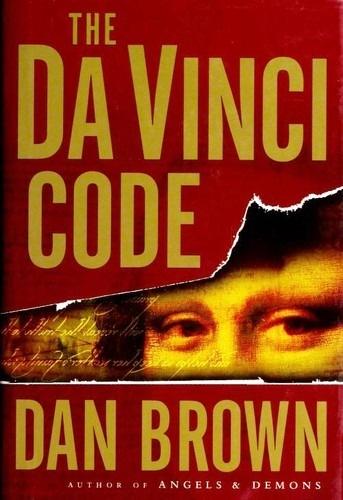
NO. The Da Vinci Code is a treasure hunt whose only treasure is the next answer, and once you have every answer the book has nothing else to give. Read it once, if you have not already. Don't reread it.
What worked on the first read
The opening is a superb hook. The curator of the Louvre is murdered in the Grand Gallery and, before he dies, arranges his own body and leaves a trail of messages: a number sequence, a line of nonsense, a symbol. Harvard symbologist Robert Langdon is summoned, and the police cryptologist Sophie Neveu, who turns out to be the curator's estranged granddaughter, warns him that he is the chief suspect. Within a few chapters they are on the run with a riddle to solve, while an Opus Dei monk named Silas hunts the same secret on behalf of a figure known only as the Teacher.
On first read the design is hard to resist. The chapters are very short and almost all of them end on a turn, and Brown cuts between his pursuers and pursued constantly. The codes are pitched at exactly the right difficulty: hard enough that you feel clever following them, easy enough that you never stop. The anagram scrawled near the body, which resolves into the names of Leonardo and his most famous painting, is a genuinely fun reveal. And the book's larger claims, about secret societies and suppressed history, give it the frisson of a conversation everyone was having at the time.
What collapses on a second read
Almost everything, because almost everything is in service of the next answer. A puzzle thriller can survive rereading if its puzzles are part of a story you want to revisit, or if knowing the solution lets you admire how the clues were laid. Here, the clues are mostly arbitrary. They do not emerge from character; they are delivered, and solved, on schedule.
The characters do not gain anything on a return. Langdon is a lecture with legs, and on a second read the lectures become the book's dominant texture: long passages in which someone explains art history or church history to someone else who conveniently does not know it. The first time, those explanations feel like the payoff. The second time, you notice how often the action stops so that they can happen, and how much of the "secret" material is presented as fact in ways that do not hold up to a moment's checking.
The prose has no reserves either. It is functional and quick, which is exactly right for one fast pass and exactly why there is nothing to savour on another. No sentence reads better the second time.
The moment test
The test case is the unmasking of the Teacher as Sir Leigh Teabing, the genial, wealthy scholar who has sheltered Langdon and Sophie and walked them through the theory at the heart of the book. On first read it is a solid turn: the friendly expert was the enemy, and his long, enthusiastic tutorials suddenly look like manipulation.
On a second read it is a good test of whether Brown planted it fairly, and the answer is only partly. Teabing's eagerness and his convenient resources look a little more suspicious when you know, but there is no layer of double meaning in his scenes. They play the same way, with the same exposition, and the irony never blooms. The same is true of the cryptex and its final password, which is satisfying exactly once: a clever little click, and then just a word.
The final pages, with Langdon following a line under Paris back to the Louvre, are the book's one attempt at grace. They are pleasant to reread. They are also two pages long.
The shelf verdict
Donate it, or pass it to someone who has never read it and does not mind the liberties with history. The first read is worth it as a cultural artifact and a clean demonstration of how to build momentum out of short chapters and riddles. It does what it sets out to do.
But it sets out to be consumed, not revisited. Five years from now you will remember the body in the Louvre and the shape of the big idea. You will not remember a sentence, and you will not need to.
NO. Read it once. Don't reread it.