Verdict: YES · 1962
Pale Fire: the novel you only finish on the second pass
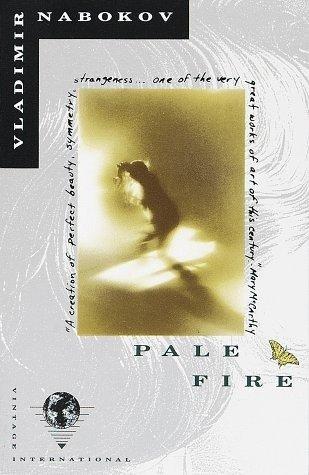
YES. Pale Fire is barely the same book the second time: on first read you follow a story, and on the second you finally see the machine that tells it.
What worked on the first read
The pull is the format, which looks at first like a stunt. A Foreword, a poem of 999 lines in four cantos by the American poet John Shade, a long Commentary by his neighbour and self-appointed editor Charles Kinbote, and an Index. The poem is lucid and autobiographical: Shade's childhood, his long marriage to Sybil, the death of their daughter Hazel, his preoccupation with what, if anything, comes after death. The Commentary ignores almost all of that.
The great comic engine of a first read is watching Kinbote hijack the apparatus. He seizes on a line about some household detail and uses it to launch pages about the distant northern kingdom of Zembla, its deposed king, the king's escape, and an assassin named Gradus making his slow way across Europe and America. Kinbote is vain, wounded, lonely and very funny, often without meaning to be. On first read you are working out how much to believe him, which is to say not much, and the pleasure lives in the gap between what the poem says and what he insists it says.
The poem opens with a famous couplet: "I was the shadow of the waxwing slain / By the false azure in the windowpane." A bird flying into its own reflection is the right image for the whole book, and you will not understand why until later.
What holds up on a second read
Everything that matters, because the second read is the one Nabokov designed. The book practically instructs you to read out of order, flipping between poem and note, and you cannot do that properly on a first pass because you do not yet know where anything is. Second time, you can read the poem whole and then the Commentary, or move between them line by line, and the two halves start talking to each other.
What emerges is a much sadder novel than the first-read comedy. Kinbote's Zembla is no longer a joke but a refuge, and the stray hints about his life in New Wye, the colleagues who mock him, the students who keep their distance, the rented house and the long nights watching the Shades' windows, assemble into a portrait of a man in real distress. Meanwhile Shade's poem, which Kinbote finds disappointing because it is not about Zembla, turns out to be the most humane thing in the book: a father trying to think honestly about his daughter.
The puzzles become visible too. Entries in the Index send you in circles. Names recur, and words turn up reversed and rearranged. Small details in the Commentary hint at other readings of who Kinbote really is, readings that critics have argued over for decades and that the book never settles. None of this is necessary to enjoy Pale Fire once. All of it is why you go back.
The moment test
The passage in Canto Two about Hazel. On first read it arrives in the middle of a poem you are reading partly to see what Kinbote will do with it, and it can feel like an interruption to the Zembla story. Shade cuts between a quiet evening at home, himself and Sybil in front of the television, and Hazel out alone on a winter night, heading toward the frozen lake.
On a second read, knowing exactly where the passage is going, it is close to unbearable, and that is to its credit. The cross-cutting, which seemed like a formal trick, becomes the point: two parents carrying on an ordinary evening while the worst thing in their lives is happening a few miles away. Then you turn to the Commentary on those lines and notice how quickly Kinbote's notes drift away from Hazel and back toward himself. His inability to stay with another person's grief becomes one of the book's sharpest effects, and you only see it once you know where to look.
That is the shape of Pale Fire on a return. The comedy is still there, and still funny. But it now sits beside the poem's grief instead of on top of it.
The shelf verdict
Keep, and keep it within reach. Pale Fire is a book whose first read is an introduction to a second, and whose second is an introduction to a third. It is showy and playful, and underneath it is more tender than its reputation admits. Each return finds a different emphasis: the comedy, the puzzle, the grief. Which one dominates seems to depend on the age of the reader as much as on the text.
It also lends itself to partial returns in a way few novels do. You can reread the poem alone in an hour, or follow a single thread through the Index on a slow evening, and come away with something new.
YES. Come back every few years, and read the poem first.