Verdict: YES · 2004
Cloud Atlas: the nesting dolls open wider the second time
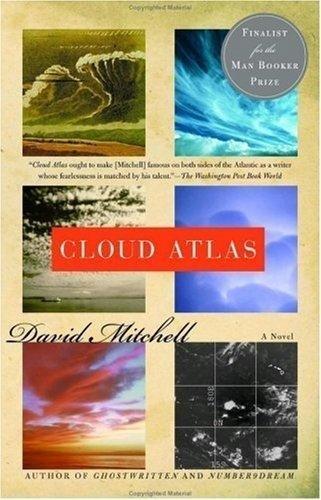
YES. Cloud Atlas is a structure you can only admire from inside on the first read; on the second you can walk around it, and it turns out stranger and sturdier than it looked.
What worked on the first read
The first-read pull is the sheer range. Six narratives, each in a different genre and voice, nest inside one another: a nineteenth-century Pacific journal, letters from a young composer in 1930s Belgium, a 1970s conspiracy thriller, a present-day comic caper about a vanity publisher, an interrogation transcript from a corporate future Korea, and a post-collapse oral tale told on Hawaii. The first five break off partway through, the sixth runs uninterrupted, and then the book climbs back out through the second halves in reverse order.
On first read, the pleasure is in Mitchell's mimicry and in the jolt each time a story is cut off. Adam Ewing's journal stops mid-sentence. Robert Frobisher's letters to his friend Sixsmith are dazzling and cruel. Luisa Rey's chapters are pulpy in exactly the right way. Timothy Cavendish is laugh-aloud funny. Sonmi~451's testimony is the emotional peak, and Zachry's dialect-heavy story at the centre is both the hardest section to read and the one that most rewards the effort. You keep turning pages partly to find out how the halves will rejoin.
What holds up on a second read
The architecture, and then some. On a first read, the links between stories, each narrative turning up as a document, a manuscript, a film or a recording in the next, feel like clever stitches. On a second they become the argument. Every story is literally consumed by the one after it: Frobisher reads Ewing, Luisa reads Frobisher's letters, Cavendish reads Luisa's manuscript, and so on up the chain. The book is about how stories travel, survive, get misread and get used, and you only really feel that once you can hold all six in your head at once.
Frobisher's own composition, the Cloud Atlas Sextet, is described in his letters in terms that match the novel's structure, and on a second read that description becomes a reading guide. The recurring comet-shaped birthmark looks less like a gimmick and more like an open question Mitchell declines to answer: are these people connected by anything more than the reader's attention?
The book's preoccupation with predation, strong over weak, one people over another, corporations over persons, also deepens on a return. On first read it can feel like a thesis repeated six times. On a second the variations matter more than the theme: the same hunger takes the shape of a colonial voyage, an energy company, a care home, a state. The Cavendish section, which seems lightweight the first time, turns out to be a necessary breath and, beneath the farce, one more story about confinement.
What sags a little is the Luisa Rey thriller, which is meant to read like a paperback and on a second pass can read a bit too much like one. That is a small price.
The moment test
The hinge at the very centre, where Zachry's story ends and the book turns back toward the second half of Sonmi's. On first read this is a relief: you have pushed through the densest dialect in the novel and are glad to return to something more familiar. The turn feels like a structural reward and not much more.
On a second read it is the most moving point in the book. You know by now what Sonmi's words have become in Zachry's world, a kind of scripture, revered and partly misunderstood, cut loose from the person who spoke them. Turning back to her own voice after that is like reading a sacred text and then hearing the woman who actually said it, in a cramped room, to a man with a recording device. The descent and the climb back out stop being a formal trick and become the book's real subject: what is lost and what is kept as words pass forward through time. Knowing what is coming does not weaken the moment. It is what gives it weight.
The shelf verdict
Keep. Cloud Atlas becomes more coherent and more humane the more familiar you are with it, and the second read is the one where the six voices finally sound like one book. It is also a novel you can reread in pieces: pick a single story, read its two halves back to back, and see how it holds up alone. Most of them hold up well. Read in order again, they hold up better.
Five years from now, the dazzle will have faded, which is fine. The dazzle was never the point. What lasts is the shape, and the shape rewards a reader who already knows it.
YES. Return every few years, and give the centre the time it asks for.