Verdict: YES · 1872
Middlemarch: the novel that keeps getting older with you
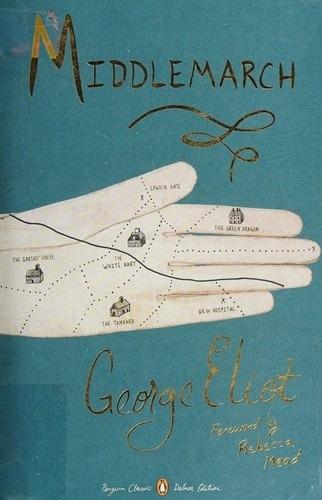
YES. Middlemarch is the rare long novel that is better the second time, and better again the third, because it was written for a reader who has already lived a little.
What worked on the first read
The pull of a first read is old-fashioned and strong: who marries whom, and how badly it goes. Dorothea Brooke, nineteen, earnest, and hungry for a life of some consequence, accepts the scholar Edward Casaubon, a dry man nearly three decades older who has spent years on a book meant to explain the world's mythologies. Across town, the ambitious young doctor Tertius Lydgate arrives with plans to reform medicine and falls for Rosamond Vincy, the prettiest and most polished young woman in Middlemarch. You can see both mistakes coming from a long way off, and the novel lets you watch them happen anyway.
Around those two marriages are smaller plots that turn out to carry just as much weight: Fred Vincy, Rosamond's charming, idle brother, and Mary Garth, who will not take him seriously until he earns it; the banker Bulstrode, pious and powerful and plainly hiding something; Will Ladislaw, Casaubon's young cousin, who keeps turning up where Dorothea is. The book first appeared in eight parts, and you can feel the serial pacing in the way each part ends with a door half open.
On first read the narrator can feel like an interruption. Eliot steps in often to generalise, to explain, to ask the reader to extend sympathy to people the story has just shown at their worst. At twenty, that voice can seem like a lecture between scenes.
What holds up on a second read
The narrator is what holds up, and then some. On a second pass the commentary stops feeling like an interruption and becomes the reason to come back. Eliot is not judging her characters from above; she is showing how each of them is the centre of their own story, and how often they are wrong about the people beside them. The famous image in chapter 27, of scratches on a polished surface that seem to arrange themselves in circles around whatever candle you hold up to them, is the method of the whole book. Every character is holding a candle.
Knowing the plot frees you to notice how carefully it is built. Small decisions in the first books, a debt, a will, a casual introduction at a dinner, become the hinges of the last ones. Lydgate's story, which can feel secondary on a first read, turns out to be the most painful thing in the novel: a talented man who is never once a villain, worn down by money, by marriage, and by the town.
The book also changes as the reader ages. At twenty you read Dorothea and wish she would choose better. At forty you read Lydgate and Rosamond and recognise the slow arithmetic of a marriage running on different assumptions. Later still, Casaubon himself, fearful and proud and aware that his great work will never be finished, stops being a joke and becomes the saddest man in English fiction.
The moment test
Chapter 29 opens on Dorothea in her new married life and then stops itself: "but why always Dorothea?" The narrator turns away from the heroine to Casaubon, and asks the reader to consider how this marriage looks from inside his head.
On first read it is a jolt, almost a scolding, just as you had settled into rooting for Dorothea. On a second read it is the moment the whole novel explains itself. Middlemarch refuses to have one centre. That single question licenses everything that follows: the long attention paid to Lydgate, to Bulstrode, to Fred and Mary, to the ordinary people whose choices add up to the life of a town. Knowing where the book is going makes the turn feel generous rather than abrupt.
It also sets up the late chapters, where Bulstrode's buried past finally catches him and Lydgate is drawn into the scandal by a loan he needed and did not look at too closely. On first read those chapters play as plot. On a second, knowing Casaubon's will and its humiliating condition about Ladislaw, knowing that Dorothea will give up her fortune, you see the same pattern in every strand: people bound by money and by what the town will say. The final page, with its line about how "the growing good of the world is partly dependent on unhistoric acts", reads as an epitaph on a first visit and as a quiet instruction on every return.
The shelf verdict
Keep, permanently, and in an edition with a good binding. Middlemarch is long enough that most people only get through it once, and that is a mistake. The first read gives you the plots; the second gives you the narrator; the third gives you yourself, older, recognising someone you used to dismiss.
YES. Once a decade, at least.