Verdict: MAYBE · 2002
Kafka on the Shore: a dream worth reentering, if not end to end
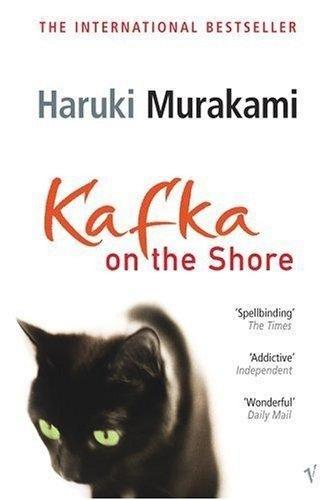
MAYBE. Kafka on the Shore is a dream novel with two halves, and only one of them gets better when you know where it goes.
What worked on the first read
The pull is the architecture. Chapters alternate between two stories that seem to have nothing to do with each other. In one, a fifteen-year-old who calls himself Kafka Tamura runs away from his father's house in Tokyo, carrying a grim prophecy his father has laid on him, and ends up in the city of Takamatsu, in a small private library run by the gentle, sharp-tongued Oshima and the remote Miss Saeki. He narrates in the first person, with an imagined companion, the boy named Crow, who speaks to him in passages set apart from the rest.
In the other, told in the third person, an elderly man named Nakata, who lost his memory and his ability to read after a strange incident in his childhood during the war, lives on a small allowance and earns a little extra finding lost cats, which he can talk to. When his search for one missing cat leads him to a man who calls himself Johnnie Walker, his quiet life breaks open and he sets off west, without quite knowing why.
On first read the suspense is the gap between the two lines. You keep waiting for them to meet and explain each other. Murakami feeds that hope with recurring images, a song, a painting, a stone, strange weather, and the momentum carries you through a long book quickly.
What holds up on a second read
Half of it, and it is not the half you expect. Kafka's chapters were the hook on first read, and they are the ones that thin out on a return. Once you know that the prophecy and the mysteries around Miss Saeki will not be resolved in any conventional way, his story starts to feel like a set of symbols arranged around a sullen, self-absorbed boy. Its sexual material, which on first read you may take as dream logic, reads on a second pass as uncomfortable, and the book's refusal to examine it does not help. Some of the big conversations at the library, where Oshima holds forth on Greek tragedy, irony and Schubert, sound more like lectures on a return.
Nakata's chapters are the reverse. Without the pressure of wondering where it is all going, you can simply enjoy the old man's courtesy, his literal-minded speech, his conversations with cats, and above all the arrival of Hoshino, the young truck driver who gives him a lift and, almost by accident, becomes his protector. Hoshino is the most human figure in the book: bored, funny, generous without meaning to be. His gradual transformation on the road is the one character arc that genuinely deepens on a reread.
This is the MAYBE. The novel's mysteries were never designed to unlock, so a second read doesn't reveal a hidden plan. What it does is let you choose which dream you prefer.
The moment test
Hoshino, killing time in Takamatsu, drifts into a coffee shop and hears Beethoven's Archduke Trio. He knows nothing about classical music, and he finds himself listening, then thinking about his own life, then asking the owner about the piece.
On first read this is a small, quiet interlude between stranger events, and you may hurry past it to get back to the mystery. On a second read it is one of the best scenes in the book. Knowing that the plot will not give you a key, you notice that this is what the novel is actually about: people being changed by things they cannot explain. A truck driver in a café, hearing music for the first time, is a better image of that than any of the talking cats or the stone. The scene gets better each time, because it never depended on suspense.
The shelf verdict
Lend it, and keep the Nakata chapters in mind. Kafka on the Shore is a big, generous, uneven novel whose first read works on mystery and whose second works only in part. You can follow the even-numbered chapters on their own one long weekend and come away with most of what the book has to give on a return.
A full reread is a mood decision, not an urgent one: when you want strange weather and long walks rather than answers.
MAYBE. In another decade, starting with Nakata.