Verdict: MAYBE · 2014
All the Light We Cannot See: lovely rooms, thinner the second time
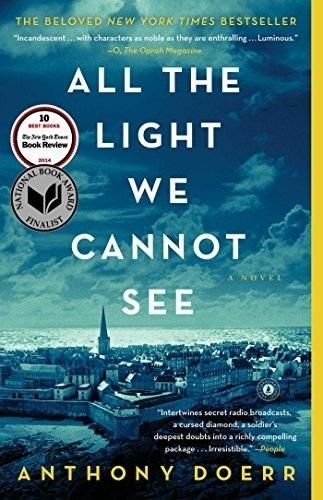
MAYBE. All the Light We Cannot See is a beautiful first read built for momentum, and on a second pass the momentum is gone while the beauty is only partly left.
What worked on the first read
The structure does most of the pulling. Two lives run in alternating chapters, many of them only two or three pages long. Marie-Laure LeBlanc, blind since early childhood, grows up in Paris, where her father is a locksmith at the natural history museum and builds her a scale model of their neighbourhood so she can learn its streets with her fingers. Werner Pfennig, an orphan in a German mining town, teaches himself to repair radios and is sent to an elite Nazi school because of it. The book keeps cutting back to August 1944, when Allied bombers are attacking the walled town of Saint-Malo, where Marie-Laure is hiding and where Werner is trapped in a cellar. You know from early on that the two lines must meet there, and the short chapters keep promising that the next one will bring them closer.
The sentences are precise and sensory, and they suit a book narrated so often through a blind girl's hands and a boy's ears. Shells, snails, keys, radio static, the sound of the sea against the ramparts: Doerr is very good at small physical things. On first read the polish is part of the pleasure.
There is also a plot device designed to keep the pages turning: a diamond from the museum, said to carry a curse, which may have been entrusted to Marie-Laure's father as the Germans approached Paris, and a German gemologist who wants it badly.
What holds up, and what doesn't, on a second read
What holds up is the imagery and a handful of set pieces. The model town is still a lovely invention, and the little puzzle-box houses her father carves for her birthdays play well even when you know what they are for. The radio thread holds up best of all. Werner and his sister Jutta, as children, listen at night to a French science broadcast for young people, and that voice turns out to belong to the house where Marie-Laure ends up. On a reread you see how early the connection is planted, and it is one of the few places where knowing the ending adds something.
What thins is nearly everything engineered for suspense. The diamond plot is thriller machinery, and its villain is drawn in one colour. Once you know where the stone ends up and what becomes of the man hunting it, his chapters read as delay. The short chapters that felt propulsive the first time feel choppy the second, cutting away from scenes just as they settle. And the prose, so pleasurable on first contact, reveals its habits on a return: the same lyrical cadence at every emotional peak, the same careful closing image. It is very good writing that rarely varies its register, and a second read notices.
The characters are sympathetic but not deep enough to repay close return. Werner's moral compromise at the school is the most interesting thing in the novel, and the book moves past it faster than it should.
The moment test
The night the two lines touch without meeting. During the siege, Marie-Laure reads aloud from Twenty Thousand Leagues Under the Sea over the house's transmitter, and Werner, buried with his unit under rubble, hears her voice.
On first read this is the emotional climax of the build-up, and it works. The radio motif, the book about the sea, and the girl alone in the attic all converge. On a second read the scene is still moving, but you can see the gears: the novel has arranged everything so that this exact transmission reaches this exact receiver. It is affecting and a little too neat, and both feelings are stronger once you know it is coming.
What follows is harder to sit through twice. Werner and Marie-Laure do meet, briefly and tenderly, and then he walks away and is killed soon after, in a way that feels arbitrary by design. On first read the shock carries real grief. On a second, the long epilogues set decades later, which tidy up survivors and objects and inheritances, feel like the book reluctant to let go. The best ending is the meeting itself, and the novel does not stop there.
The shelf verdict
Lend. This is a book to give to someone who has not read it, because a first read is genuinely moving and the short chapters make it easy going for a long novel. Keep a few chapters marked if you own it: the model town, the childhood radio broadcasts, the reading in the attic. Those are worth returning to on their own.
MAYBE. Ten years from now, maybe, for the radio chapters.